



New Rhino calf Mo a few hours after her birth. Photo credit: Rory Carnegie
Recently, Cotswold Wildlife Park had a rather unexpected arrival. White Rhino Ruby gave birth to an adorable female calf (pictured above). Keepers knew Ruby was pregnant, but the actual birth came as a bit of a surprise and a little earlier than expected. The newborn is the thirteenth Rhino born at the collection in the last twelve years. The calf’s mother was named after writer, comedienne and long-time friend of the Park, Ruby Wax, shortly after arriving from South Africa in 2009. The new addition is her sixth calf with breeding male Monty.
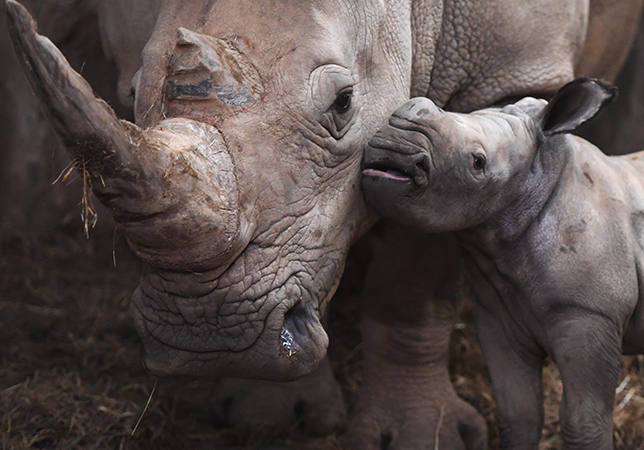
New Rhino calf Mo at 7 days old. Photo credit: Paul Nicholls Photography
It’s been a remarkable year for the Rhino family. Recently, White Rhino Nancy gave birth to a male calf named Markus. Births in captivity are extremely rare. At the time, he was the only White Rhino born in the UK in 2025. Ruby’s new arrival means that Cotswold Wildlife Park has successfully produced the UK’s only two White Rhino calves this year. In total, including these new siblings, just six White Rhinos were born in European zoological collections in 2025.
The Park’s Curator and Managing Director, Jamie Craig, commented: “To have such a successful record breeding this incredible species is down to our team of dedicated keepers. A paddock full of Rhino is a great sight and the new arrivals are certainly keeping the team on their toes”.
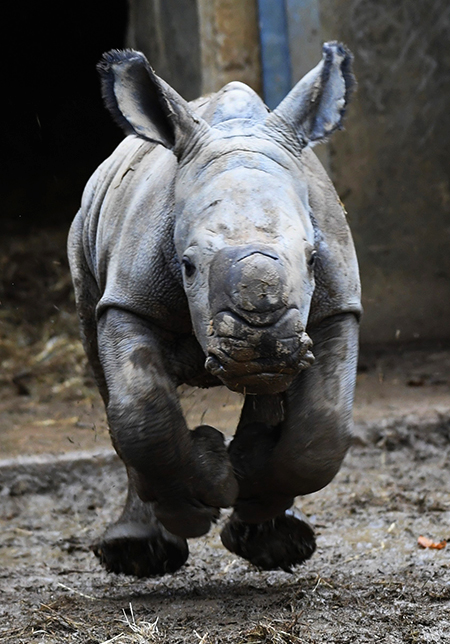
New Rhino calf Mo at 7 days old. Photo credit: Paul Nicholls Photography
Ruby’s calf is proving to be a high-spirited and confident youngster. Her energetic outbursts have been entertaining visitors who have delighted in watching her ‘play-charge’ the other Rhinos, including her half-brother Markus, out in the large Rhino paddock. Ruby is an exceptional and very protective mother and the pair have formed an intensely strong bond. The calf has been named ‘Mo’ in honour of a much-loved member of staff, Mrs Maureen Clifford. The key person at the heart of the Park’s main office from 1978 until her retirement in 2017, her enduring contribution to the Park spanned almost four decades. Maureen, affectionately known as ‘Mo’ to close friends, still visits with her family and is delighted that the new calf is named after her.
It is rare to catch Rhino births on camera as females usually give birth during the night. Luckily, the day Ruby unexpectedly went into labour, Conservation Officer Bethan Peacock managed to capture the event on camera. Just thirty minutes after her birth, Mo was taking her first wobbly steps with mum Ruby gently encouraging her newborn to stand with a little help from her horn. She will remain under the watchful eye of Ruby, suckling from her for approximately one year. The calf will stay with her mother for at least two years, benefiting from her protection. Females guard their offspring aggressively and are intimidating adversaries if challenged.
The new arrival brings the total number of Rhinos currently at the Park to nine – the highest number residing at the collection at any one time in its fifty-five year history. It is also one of the largest family groups on show anywhere in the country. Visitors can see the new calves in the solar powered Rhino House or in the large Rhino paddock (weather permitting).
Protecting wildlife beyond the Park
The White Rhino is living proof of conservation success. They were once the rarest subspecies of any Rhino and were on the verge of extinction in the early 1900s, when it was believed less than fifty animals remained in their native African homeland. Thanks to excellent and sustained protection, they are now the most common of the five Rhino subspecies, although poaching in the last five years has once again escalated to serious levels, driven by demand for Rhino horn from the traditional medicine market of China and the Far East. Three of the five Rhino species – the Black, Javan and Sumatran – are critically endangered.
Cotswold Wildlife Park is committed to Rhino conservation and works closely with the UK-based conservation charity Tusk to protect Africa’s many threatened species. Over the last ten years, the Park has raised over £120,000 for Tusk’s conservation work in Africa through various fundraising events. In October 2021, Reggie Heyworth, the Park’s Chairman and a Tusk Trustee for nine years, ran the London Marathon in aid of Tusk and raised over £12,000 for the charity. For more information about Tusk please visit www.tusk.org
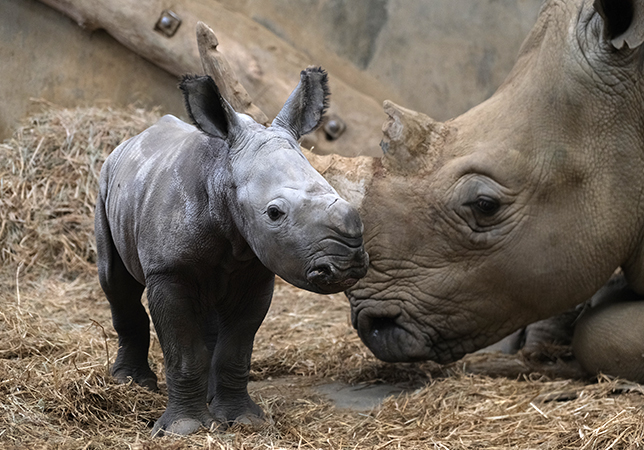
New Rhino calf Mo a few hours after her birth. Photo credit: Rory Carnegie
Additional information:
- Monty and Ruby are both nineteen years old. In 2009, Ruby, along with another female called Nancy, made the eleven thousand kilometre journey from Mafunyane Game Farm in South Africa to the UK to join young male Monty at their new Oxfordshire home.
- Females only reproduce every two to three years, so the window of opportunity for successful reproduction is limited. After a gestation period of sixteen to eighteen months, a single calf is born.
- Ruby’s first calf was born in 2015. He was named Ian in memory of the highly respected South African conservation scientist, Ian Player, who spearheaded efforts to rescue the Southern White Rhino from extinction. The Park’s original Rhino pair, Lebombo and Somtuli, arrived from Umfolozi Game Reserve in 1972 as a direct result of Ian’s conservation initiatives with South Africa’s Natal Parks Board.
- White Rhinos (Ceratotherium simum ssp. simum) were one of the first large mammals to join the collection which was founded by Mr John Heyworth in 1970. They are the largest of the five Rhino species and the second largest land mammal after the Elephant.
- White Rhinos are the most social of all Rhinoceroses. Females and their young associate in groups of up to 14 animals.
- African Rhinos lack any front teeth. Instead they have large, tough and mobile lips.
- Their horns grow at a rate of approximately one inch per year.
VISITOR INFORMATION: Cotswold Wildlife Park is currently open daily (except Christmas Day) from 10:00 am until 4:00 pm (with last admission being at 3:00 pm).
Please note: Our winter opening times change from Monday 5th January 2026. Cotswold Wildlife Park will remain CLOSED on WEEKDAYS ONLY from 5th January until 5th February (re-opening on Friday 6th February 2026); EXCEPT FOR WEEKENDS when the Park will be OPEN from 10.00 am until 4:00 pm or dusk (whichever is earlier, with last admission being at 3:00pm). This is to allow for essential maintenance to be carried out. For more information, please visit: www.cotswoldwildlifepark.co.uk/plan-your-visit/opening-times – many thanks.
Photo credits: Rory Carnergie and Paul Nicholls Photography