



Photo credit: Primates, Small Mammals and Birds Keeper Sophie
Not only has 2025 been a record-breaking year for visitor numbers, but it has also been the most successful breeding season on record for one of the collection’s rarest species – the Greater Bamboo Lemur (Prolemur simus). Recently, the Primate Team celebrated the arrival of four Greater Bamboo Lemur babies (one pictured above). Births in captivity are extremely rare. In fact, the Park is the only zoological collection in the UK and one of three worldwide to have bred these rare primates this year. With a population of 13, Cotswold Wildlife Park is now home to the biggest breeding group in the world.

Photo credit: Primates, Small Mammals and Birds Keeper Sophie
Natalie Horner, Section Head of Primates, Small Mammals and Birds, explains why every breeding success is important: “The Greater Bamboo Lemur is one of the most endangered species of Lemur, found only in the rainforests of eastern Madagascar. Classified as “Critically Endangered” on the International Union for the Conservation of Nature (IUCN) Red List of Threatened Species, today the global population is estimated between 1,200-1,500 individuals. This is fewer than higher profile species such as the Black Rhino, Tiger and Giant Panda. They are threatened by habitat destruction and fragmentation, which leads to the isolation of the different populations by forest degradation. They are also affected by hunting and mining which causes water pollution”.

Photo credit: Deputy Head of Primates, Small Mammals and Birds Richard Wardle
Natalie adds: “There are only 41 Greater Bamboo Lemurs in captivity across 9 institutions globally. Here at the Park, we are home to 13 individuals. Our group first successfully bred during lockdown in 2020. Since then, our male Raphael and females Bijou and Veloma have produced 9 youngsters. Bijou and Veloma (pictured above with her baby) are wonderful mothers and Raphael is such a playful dad. We have a second group of Greater Bamboo Lemurs, formed with two of our female youngsters born in 2021 and a male from Zoo Lyon. This group had their first breeding success this year with Nomena and Fotsy both producing their first young. This means we are now home to the largest number of Greater Bamboo Lemurs in captivity! We are incredibly proud that both our groups have produced young this year, meaning we have four baby Bamboo Lemurs who are all going from strength to strength every day. They have all had their first taste of solid food and are becoming more confident, spending some time away from their mothers playing and exploring their enclosures”.
The as-yet-unsexed and unnamed new arrivals have made their debut ahead of World Lemur Day (31st October 2025) and visitors can see Bijou and Veloma’s babies inside the Park’s Lemur exhibit Madagascar.
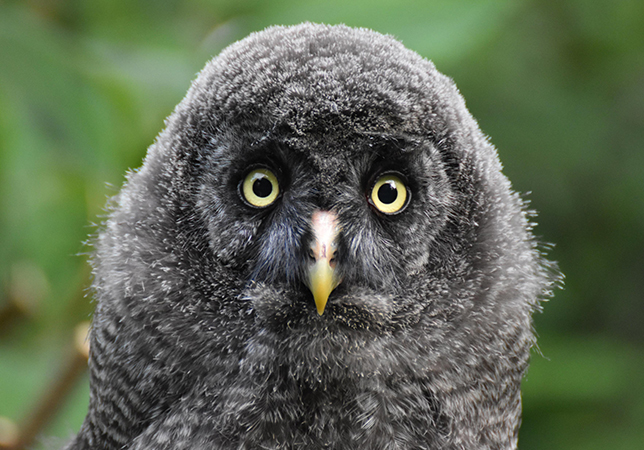
Photo credit: Reptile Keeper Matt
It has also been an eventful breeding season for the Bird Section. The Great Grey Owls (Strix nebulosa) surprised keepers by producing their first brood. Bird Keepers Dom and Lucy explain: “Our Great Grey Owls were introduced to each other in late 2021 so are a relatively recent pairing. Over the last three years, they have attempted to nest but to no avail. This year, after some tweaking of their nest material, our patience was finally rewarded when two little faces poked up out of the nest box! A couple of days later, a third chick appeared. A week later, much to our delight, we saw another chick in the nest box bringing our total to four – two males and two females. All have now successfully fledged and are sporting a scruffy look as they go through their moult. It’s been a very rewarding experience for us as keepers and has brought us a lot of joy!”. Visitors can see the Great Grey Owl family in their aviary opposite the Pallas’s Cat exhibit.
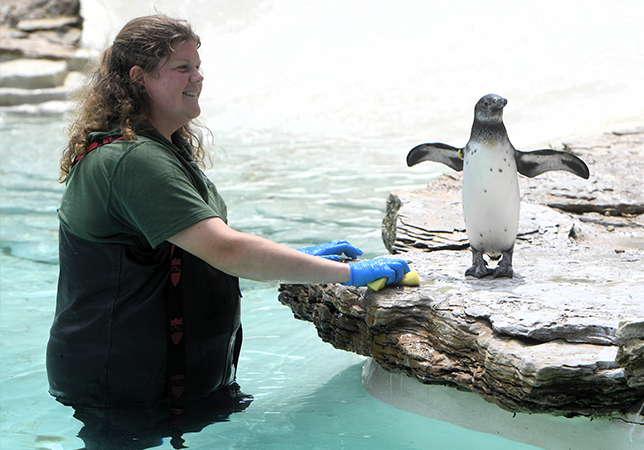
Photo credit: Paul Nicholls Photography
Meanwhile, the Humboldt Penguins (Spheniscus humboldti) have had their most successful breeding season in ten years with the addition of four chicks. One in particular caught the attention of visitors due to its special bond with one of the keepers. Whenever Bird Keeper Laura steps into the Penguin enclosure, a chick called Pippin follows her wherever she goes. She often stands by Laura’s side during the daily visitor Penguin talks and swims alongside her whenever she’s cleaning the pool (pictured above). The reason for this bond started soon after the chick hatched. Pippin was abandoned in the nest by her parents when she was four weeks old. Without intervention, she wouldn’t have survived. Laura, along with the other Penguin Keepers, took on the role of surrogate mother by taking care of the chick in the Park’s specialist incubation room.
After nearly two months of hand-rearing, Pippin was slowly introduced to the colony under the watchful eye of the keepers. Laura said: “Pippin is thriving and loves playing with the other youngsters in the water. She still follows me whenever I’m in the enclosure, especially when I’m cleaning the pool. She won’t leave my side! She’s grown into such a confident young Penguin and we’re very proud of Pippin”.
Chicks Pippin, Beryl and Oreo (hatched to first-time parents Ripley and Pebble) can often be seen enjoying a swim in the Penguin pool. The fourth as-yet-unsexed and unnamed chick will hopefully join them soon as it has just started to venture out of the nest box.
Lastly, Yellow Mongoose pair Chip and Nutmeg have enjoyed their best breeding season since joining the Park. Last year, Nutmeg gave birth to her first litter (and the only Yellow Mongoose twins born in a UK zoological collection in 2024). This year, the pair have produced four adorable pups. Two were born back in the spring and two as-yet-unsexed babies (one pictured below) are just beginning to leave their underground burrow and explore their outside exhibit near the Amphibian Breeding Room.

Photo credit: Brian Lilly
As well as these new arrivals, visitors can also see the Park’s other recent breeding successes on show too: Bactrian Camel calf Tillie (named after Mammal Keeper Liam’s daughter), a rather energetic young Black-and-White Colobus Monkey named Pili, Parma Wallaby joeys and Straw-Coloured Fruit Bat pups (only two other zoological collections in Europe hold this species).
Additional information
Cotswold Wildlife Park is home to more than 1,500 animals from 250 different species making it one of the largest zoological collections in the UK. The Park’s commitment to its various breeding programmes has resulted in an impressive number of new arrivals – in fact over 523 births so far this year. These births are testament to the dedication and hard work of the keepers at Cotswold Wildlife Park and the Park’s commitment to its ever-growing number of conservation programmes.
Lemur facts:
- Lemurs are considered one of the most endangered groups of mammals on earth. According to the IUCN, a staggering 98% of Lemur species – 103 out of the 107 listed – are now threatened with extinction.
- Only eight other zoological collections in the world keep Greater Bamboo Lemurs.
- A voracious appetite for bamboo makes this species Madagascar’s answer to the Giant Panda. Bamboo Lemurs are the world’s only primate with this highly specialised and almost exclusive diet of bamboo (which contains the poisonous chemical cyanide). This is difficult and dangerous food to process, yet these Lemurs have evolved to do just that.
- World Lemur Day is celebrated on 31 October 2025. Now in its 11th year, its aim is to highlight the plight of Madagascar’s most endangered primates. The inaugural World Lemur Festival was held in Antananarivo, Madagascar, in 2014 and is now celebrated around the world.
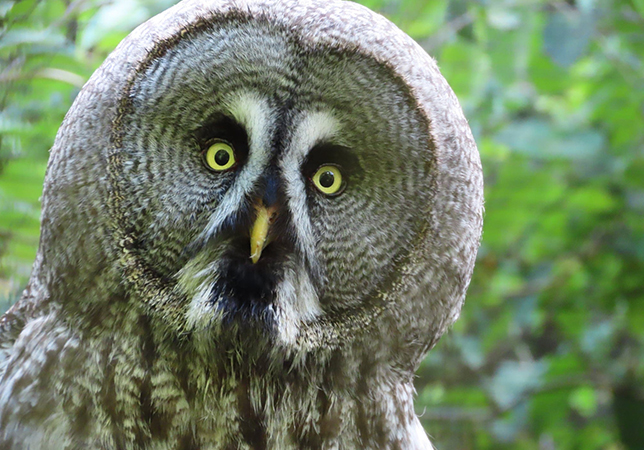
Photo credit: by Reptile Keeper Matt
Great Grey Owl facts:
- The Great Grey Owl boasts one of the largest and most perfectly circular facial discs of all the owls. It acts like a radar dish to focus the sound of moving prey onto its asymmetrically placed ears.
- Their very acute hearing can even detect small mammals moving through tunnels under more than 30cm of snow. A Great Grey Owl will crash through the snow layer to seize the prey in its talons.
- There are approximately 250 species of owls in the world – the Great Grey Owl is one of the largest.
Humboldt Penguin facts:
- The Humboldt Penguin (Spheniscus humboldti) is originally named after the cold water current it swims in, which itself is named after Alexander von Humboldt – Prussian geographer, naturalist and explorer.
- This species is classified as “Vulnerable” by the IUCN.
Yellow Mongoose facts:
- When it comes to mating, it’s a rather quick affair with Yellow Mongoose (Cynictis penicillata). Copulations lasts for about 30-60 seconds, during which the male makes a soft purring sound while the female bites or licks the male’s ear and neck continuously.
- The gestation period for Yellow Mongoose varies between 42 and 57 days.
- The Yellow Mongoose is unique among mongooses in that it is the only known species that brings large prey items such as rodents, bats or reptiles to its young while they are still in the burrow.
Thanks to Paul Nicholls Photography for his photo of Pippin with Laura, Brian Lilly for the Yellow Mongoose image, Richard, Sophie, Dom and Lucy from the Primates, Small Mammals and Bird Section for their photos of the Greater Bamboo Lemurs and Great Grey Owls.