

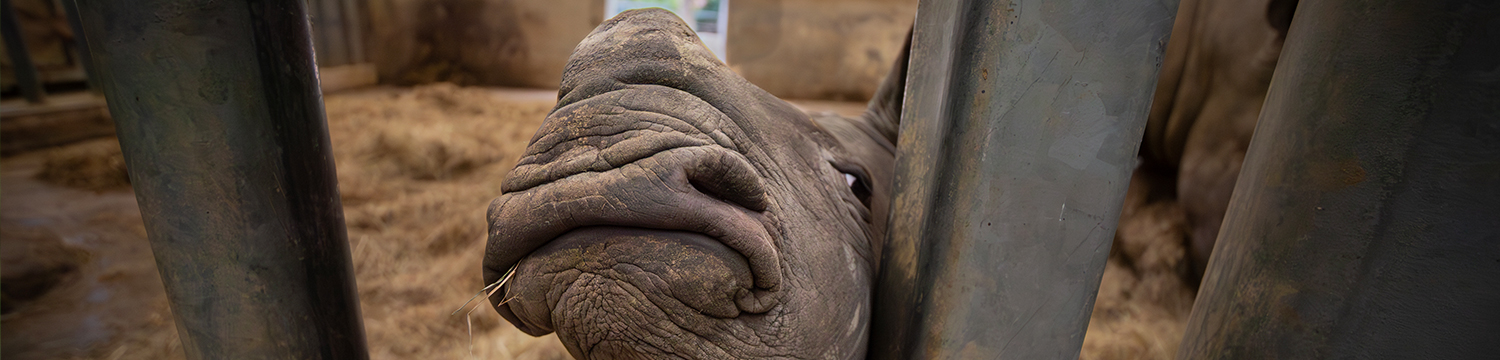
Markus is the newest addition to the Rhino family at Cotswold Wildlife Park and Gardens. He is the twelfth Rhino calf to be born at the Burford collection in twelve years – a tremendous achievement. Births in captivity are extremely rare. In fact, the Park is responsible for the UK’s only White Rhino birth this year. In total, just five White Rhinos were born in European zoological collections in 2025. The youngster is healthy and nursing well from Nancy – an exceptional and attentive mother. This is her seventh calf with breeding male Monty.
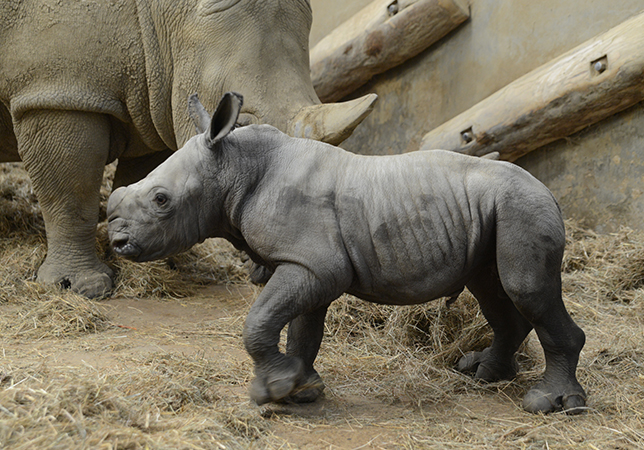
Markus soon after his birth | Photo credit: Rory Carnegie
It’s rare to catch Rhino births on camera as females usually give birth during the night. Luckily keepers were present the evening Markus was born. In less than 45 minutes, the sixteen month pregnancy was over and Nancy gave birth to a male calf. Mammal Keeper Liam Klingsick caught the moment on film (The amazing footage of the birth is below).
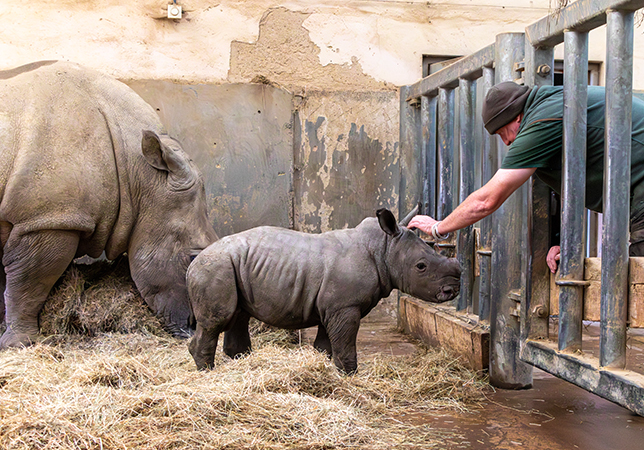
Markus in the Rhino House with Head Keeper Mark | Photo credit: Philip Joyce
Head Keeper Mark Godwin also witnessed Markus’s entry into the world. Mark has worked at the Park for 35 years and has looked after the ever-growing ‘crash’ of Rhinos for the last 12 years. Mark said: “He’s one of most confident calves I’ve seen. Newborns weigh approximately 70 kgs at birth and put on roughly 1.5-2 kgs a day in weight. If he grows into his features, he will be a big lad”.
Females only reproduce every two to three years, so the window of opportunity for successful reproduction is limited. After a gestation period of sixteen to eighteen months, a single calf is born. This is one of the longest gestation periods of any land mammal, surpassed only by the twenty-two month gestation period of an Elephant. A newborn Rhino calf will stand up within one hour of birth and immediately attempt to suckle, although he or she may be a little unsteady on their feet for the first few days. The calf will remain under the watchful eye of its mother, suckling from her for approximately one year. Their bond is an intensely strong one and the youngster will remain with her for at least two years, benefiting from her protection. Females guard their offspring aggressively and are intimidating adversaries if challenged.
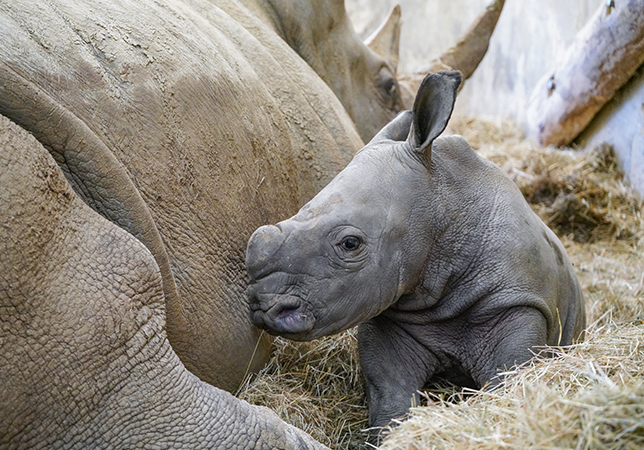
Marcus next to Nancy | Photo credit: Rebecca Louise
White Rhinos (Ceratotherium simum ssp. simum) have always been an important species at the Park and much thought is given to naming these iconic animals. The calf has been named in memory of one of the most influential conservation scientists to have worked in Africa over the last half century. Reggie Heyworth, Chairman of Cotswold Wildlife Park and Gardens, explains: “We have named our new arrival, Nancy’s 7th calf, Markus after the late Doctor Markus Borner (pictured below). He gave me my break into conservation when he was head of Frankfurt Zoological Society in Tanzania. It’s a long story but basically, he appointed me project leader of FZS’s Tanzania Rhino Conservation Programme in 1992. It sounds grand but in fact at the time there was a known population of only 12 Black Rhinos in northern Tanzania and maybe a couple of dozen dotted around the rest of the country, mostly in northern Selous Game Reserve in the southeast of the country. So there remained maybe 50 in total in the whole country, from a population of 20,000 in 1970 (very roughly estimated). The rest had all been wiped out by poachers in the 1980s.”
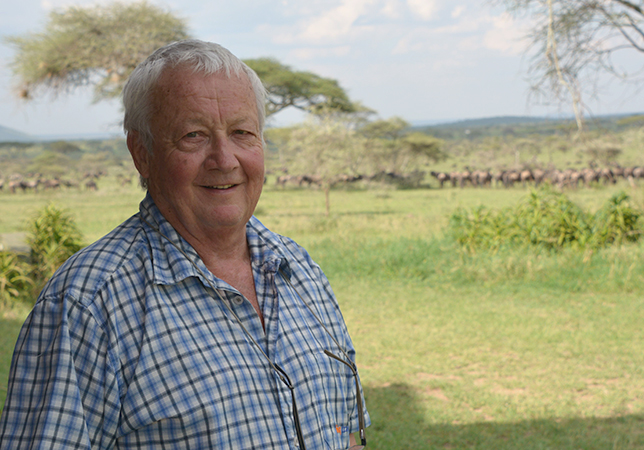
Doctor Markus Borner with wildebeest | Photo courtesy of Professor Sarah Cleaveland
Reggie adds: “In other words, everything was on the floor and the only way was up! By the time Markus died in 2020, Tanzania’s Serengeti ecosystem had substantially been re-populated with a potentially viable population of Black Rhinos and I’m not the only one who would find it difficult to think of anybody else who had more of a positive influence on that outcome than Markus Borner. He was not only a giant of conservation but also my incredibly supportive boss and he became one of my best friends”.
Doctor Markus Borner received a number of awards during his lifetime, including the prestigious Blue Planet Prize in 2016 that recognised his lifetime contribution to conservation science. Our great thanks to Professor Sarah Cleaveland for kindly sharing this image of him with us. His memory lives on in the Park’s Rhino family.
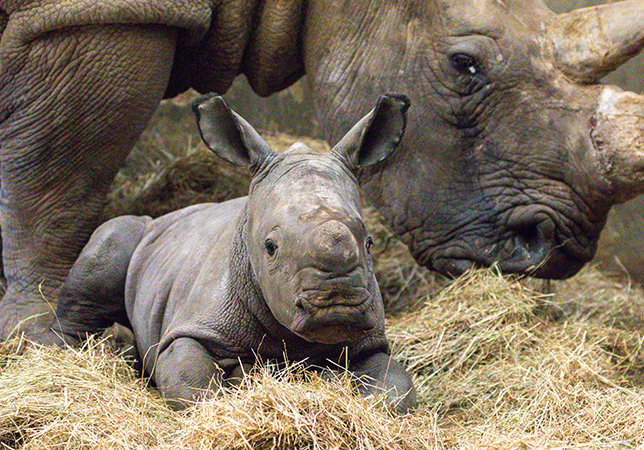
Marcus, the newest member of the Park’s Rhino family | Photo credit: Philip Joyce

Monty and Nancy mating in spring 2024
This new addition brings the total number of Rhinos currently residing at the Park to eight – the highest number on show at any one time in the Park’s fifty-five year history. It is also one of the largest family groups on show anywhere in the country. As well as filming the birth, keepers believe they may have also caught the conception on camera for the first time too (pictured left with Head Keeper Mark in the foreground). A memorable day for keepers and visitors alike as Monty’s amorous intentions lasted some considerable time and attracted quite the crowd!
Markus is proving to be a high-spirited and boisterous addition to the “crash” (the collective noun for a group of Rhinos). He has been delighting visitors with his energetic outbursts. Visitors can see the new calf daily from 10 am in the solar-powered Rhino House or the large Rhino paddock overlooking the Manor House.
Protecting wildlife beyond the Park
Cotswold Wildlife Park is committed to Rhino conservation and works closely with the UK-based conservation charity Tusk to protect Africa’s many threatened species. Over the last ten years, the Park has raised over £120,000 for Tusk’s conservation work in Africa through various fundraising events. In October 2021, Reggie Heyworth, a Tusk Trustee for nine years, ran the London Marathon in aid of Tusk and raised over £12,000 for the charity. For more information about Tusk please visit www.tusk.org
Additional information:
- Monty and Nancy are both nineteen years old. In 2009, Nancy, along with another female called Ruby, made the eleven thousand kilometre journey from Mafunyane Game Farm in South Africa to the UK to join young male Monty at their new Oxfordshire home.
- Shortly after her arrival, Prime Minister and local MP David Cameron visited the Park and named the new female Nancy in honour of his daughter.
- White Rhinos were one of the first large mammals to join the collection which was founded by Mr John Heyworth in 1970. They are the largest of the five Rhino species and the second largest land mammal (after the Elephant).
- The White Rhino is living proof of conservation success. They were once the rarest subspecies of any Rhino and were on the verge of extinction in the early 1900s, when it is believed that maybe less than fifty animals remained in their native African homeland. Thanks to excellent and sustained protection, they are now the most common of the five Rhino species, although poaching in the last five years has once again escalated to serious levels, driven by demand for Rhino horn from the traditional medicine market of China and the Far East. Three of the five Rhino species – the Black, Javan and Sumatran – are critically endangered.
- White Rhinos are the most social of all Rhinoceroses. Females and their young associate in groups of up to 14 animals. The dominant bulls are territorial and regularly mark their territory by wiping their horns on bushes or on the ground, then scrape-marking with all four feet, and finally spraying the spot three to five times with urine. They also maintain 20-30 middens (dunghills), usually on the boundaries of their territory, where they always defecate, using slow, deliberate kicks before and after defecating to excavate and scatter the pile. Females, calves and non-territorial males add their own deposits to the heap (without kicking) as though showing their allegiance.
- African Rhinos lack any front teeth. Instead they have large, tough and mobile lips.
- Their horns grow at a rate of approximately one inch per year.
- Rhinos produce about ten vocalisations, including a panting contact call, grunts, snorts associated with courtship, squeals of distress and deep growls or bellows for threats.

Markus inside the Rhino House just before his first venture outside | Photo credit: Rebecca Louise